Sister Princess wallpaper  

Monday, July 25, 2011

Sister Princess (シスター・プリンセス Shisutā Purinsesu) is a popular Japanese seinen series written by Sakurako Kimino and illustrated by Naoto Tenhiro. It began as a serialized light novel series in 1999. In 2001, a manga series and a bishōjo game for the Sony PlayStation were released. Sequels to the game were released for the PlayStation and Game Boy Advance. Sister Princess was also adapted into a Japanese anime television series.

The history of Sister Princess can be traced back to March 1999, when it first appeared in the monthly Dengeki G's Magazine. Originally, there were only nine sisters, not twelve. Readers were able to vote for their favorite sister and following the tremendous response from the fans, the magazine decided to serialize Sister Princess.

In March 2000, a decision was made to renew the series, this time by featuring the short letters that the girls wrote to their beloved brother. Three more sisters were added to the mix: Haruka, who came from Germany; Yotsuba, who came from England; and Aria, who came from France.

A year later, on March 8, 2001, the game version of Sister Princess — about the older brother spending a month with all twelve sisters, and featuring original artwork by Naoto Tenhiro—was released on the Sony PlayStation. Priced at 6800yen (9800yen for the limited edition), the game was the third best-selling title in Japan in its first week of release.


In July of the same year, a new series of stories began in Dengeki G's, right up till April 2002. While the magazine was preparing for yet another renewal of the Sister Princess stories for its May 2002 issue, a premium edition of the game (the original plus two other Christmas and Valentine side stories) was released for the Sega Dreamcast on Mar 28, 2002.

Sequels include Sister Princess 2 and Sister Princess RePure.

In September 2003, the series was retired as G's Magazine premier flagship title (replaced by another popular series, Futakoi). Despite the urging of fans, no official story elements has been produced since then.

The portrayal of events in the first Sister Princess anime is not considered canon by MediaWorks or hardcore fans. It's more commonly accepted as an alternate universe setting. The Sister Princess RePure anime is more faithful to the original magazine stories than its predecessor, and was created to answer disappointed fans. In fact, the stories told in the "second half" of each episode are actually modified versions of the magazine stories or mini-novels. There is nothing in Sister Princess RePure that contradicts the games, magazine stories or mini-novels: thus it can be considered canon, despite not actually being so.

-->read more...

AddThis Social Bookmark Button


Silent Mobius wallpaper  

Sunday, July 24, 2011

Silent Möbius (サイレントメビウス Sairento Mebiusu) is a twelve-volume manga, a 26-episode anime series, and a pair of motion pictures, created by manga artist Kia Asamiya. Both anime versions have been licensed by Bandai Entertainment. It is heavily influenced by the film Blade Runner and is centered on the lives of the Attacked Mystification Police Force (AMP), a dedicated group of all-female police officers with varying talents and personalities protecting Tokyo from an invasion of extra-dimensional creatures called Lucifer Hawks. It is published in English by Udon Entertainment; previously it was published in English by Viz Media.
In 1999 Gigelf Liqueur, aided by the Magician's Guild, set into motion a plan to open a gate between Earth and the world of Nemesis. The intent was to exchange Earth's polluted air and water with clean air and water from Nemesis. To aid in this endeavor, a huge cyclotron was built under Tokyo. Unfortunately for all involved, Ganossa Maximilian - Gigelf's old apprentice - sabotaged the plan, opening the gate early and perverting the gate for his own means. Following this event, Gigelf and the Magician's Guild battled an invasion of Lucifer Hawk (the name for the inhabitants of Nemesis) for a number of years. Gigelf was killed in 2006 and it would seem that the rest of the Guild met similar fates over the next few years.
In 2023, Rally Cheyenne, daughter of Guild member Lufa Cheyenne and born mixed heritage (her father was from Nemesis), felt partially responsible for the growing attacks on innocent humans by marauding creatures from Nemesis. She started the organization with a mere three officers (Kiddy Phenil, Lebia Maverick and Nami Yamigumo) and a sub-commander (Mana Isozaki). Over the next few years, she added Yuki Saiko, Katsumi Liqueur and Lum Cheng to the team, aiding in the fight to protect Earth from the vicious Lucifer Hawk.


-->read more...

AddThis Social Bookmark Button


Shuffle! Wallpaper contin....  

Saturday, July 23, 2011

The gameplay mostly consists of reading and listening to the conversations provided. Every now and then, a "Please Select Your Destiny" event will occur, giving the player multiple choices on how to respond. The choices selected determine who will be Rin's destined love; depending on which route the player takes, there will be between 8 and 12 multiple-choice questions. At a certain point in the visual novel, a translucent image of the destined character appears when the day changes indicating who Rin has fallen in love with after which the multiple-choice events become almost nonexistent. Near the end of the game, two sexual intercourse scenes will occur with the second scenes all including fellatio. After some more conversation the visual novel ends. After the visual novel has been completed at least once, players can view CG (computer graphics) artwork they have observed, skip to scenes or endings for characters they have viewed, and listen to music they have heard in the game.

The PlayStation 2 version varies from the personal computer (PC) version as all the sex scenes are removed. Instead, the PS2 version expands the storylines five heroines and the player may follow two new storylines: Mayumi Thyme's and Kareha's. Additionally, Kareha's younger sister Tsubomi makes her first appearance in the PS2 version during Kareha's path.

Shuffle! Essence+ allows the player to follow the storylines of seven heroines, including four new storylines: Tsubomi's, Sakura Yae's, Nadeshiko Benibara's and Daisy's. In Daisy's path, Erica Suzuran makes her first appearance as a secondary character and Ruri Matsuri appears as the second main heroine, but she does not have any sex scenes.


-->read more...

AddThis Social Bookmark Button


Shuffle! Wallpaper  

Friday, July 22, 2011

Shuffle! (シャッフル! Shaffuru!) is a Japanese visual novel developed by Navel. It was originally released as an adult game for Microsoft Windows on January 30, 2004. It was subsequently followed by an all-ages release for the PlayStation 2 (PS2) and an expanded adult release for Windows. The gameplay in Shuffle! follows a branching plot line which offers pre-determined scenarios and courses of interaction and focuses on the appeal of the female main characters. Shuffle! has been re-made into an expanded version called Shuffle! Essence+. It has expanded routes for the original five main heroines as well as new routes for six other characters. Shuffle! also has three spin-off sequels: Tick! Tack! , Really? Really! and Shuffle! Love Rainbow.
Shuffle! has made several transitions to other media. There have been two manga series based on the visual novel. The first was serialized in Kadokawa Shoten's magazine Comptiq between December 2003 and 2006. The second was a comic anthology published by Kadokawa Shoten between July 2004 and December 2005. Two anime adaptations were produced by the animation studio Asread. The first anime was twenty-four episodes in length and was broadcast in Japan between December 2005 and January 2006. The second series was a twelve-episode readaptation and was broadcast between January and March 2007. Seven light novels, two fanbooks, nine drama CDs, and seven radio drama CDs adaptations have also been produced.
The visual novel was well received whereas the first anime adaptation received mixed reviews. Across the national semi-monthly ranking of bishōjo games in amount sold in Japan, the limited edition of Shuffle! premiered in second place at the time of its release and remained in the top 50 for an additional three half-months. The normal edition premiered in ninth place at the time of its release and remained in the top 50 for an additional three half-months. Critics of the anime series were divided between whether or not the anime series set itself apart from other series in the harem genre and as to the quality of its audio and visual aspects.


-->read more...

AddThis Social Bookmark Button


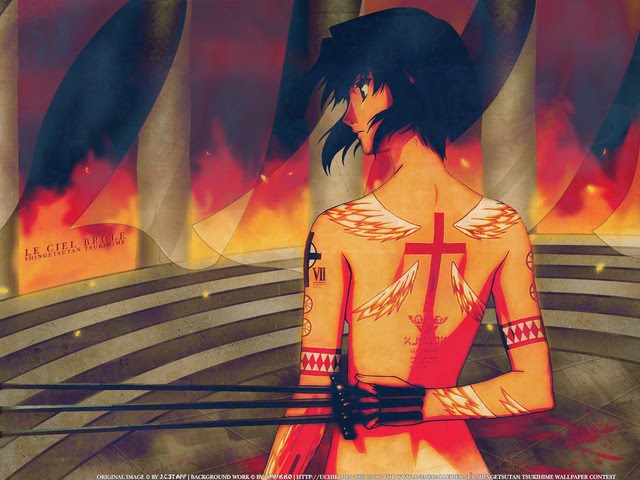
Tsukihime - Lunar Legend wallpaper  

Thursday, July 21, 2011

Tsukihime (月姫 lit. Lunar Princes) is a Japanese eroge dōjin visual novel game created by Type-Moon, who first released it at the Winter Comiket in December 2000. It was adapted in 2003 into an anime series, Shingetsutan Tsukihime, produced by J.C.Staff and Geneon, and a manga series, which has been serialized since 2004 in MediaWorks' seinen magazine Dengeki Daioh, with seven bound volumes having been released so far.

Tsukihime's official subtitle states: "Blue Blue Glass Moon, Under The Crimson Air". Its fame and renown is often attributed to its comprehensive and expansive storyline and its writer Kinoko Nasu's unique style of storytelling. As well as its anime and manga adaptations, it has also spawned numerous merchandising and memorabilia franchises. A remake to the series is also currently being planned.

An unofficial translation patch for Tsukihime was released on November 5, 2006.


-->read more...

AddThis Social Bookmark Button


Design by Amanda @ Blogger Buster