


Showing posts with label Cute Manga. Show all posts
Trigun Wallpapers
Sunday, August 21, 2011
 Trigun (トライガン Toraigan) is a Japanese manga series written and illustrated by Yasuhiro Nightow, published from 1996 to 2008 and spanning 17 (3+14) collected volumes.
The manga was serialized in Tokuma Shoten's Shōnen Captain from the series debut in 1996 until the magazine's demise in 1997. The series continued in Shōnen Gahosha's Young King Ours magazine, under the title Trigun Maximum (トライガンマキシマム Toraigan Makishimamu), where it remained until finishing in 2008.
Trigun was adapted into an animated television series in 1998. The Madhouse Studios production aired on TV Tokyo from April 4, 1998 to September 30, 1998, totaling 26 episodes. An animated feature film was released in April 2010.


Slayers wallpapers! conti...II
Friday, July 29, 2011
 A millennium before the events in Slayers, one of Ruby-Eye's fragments (which was sealed in the body of Lei Magnus, a very powerful sorcerer) revived and began the Resurrection War (降魔戦争 Kōma-sensō, alternately "War of Demon Conquering") against one of the parts of Ceiphied, the Water Dragon King, also known as Aqualord Ragradia. Ultimately, the piece of Shabranigdo won, but Aqualord, using the last remnants of her power, sealed him into a block of magical ice within the Kataart Mountains. Nevertheless, Shabranigdo's lieutenants remained at liberty, sealing a part of the world within a magical barrier, through which only mazoku could pass.
 There are four types of magic within the Slayers universe. Black magic spells, such as the famous Dragon Slave, call directly on the powers of the mazoku and are capable of causing enormous damage. White magic spells are of an obscure origin and are used for healing or protection. Shamanistic magic is focused on manipulation and alteration of the basic elements of the natural world (earth, wind, fire, water and spirit) and contains spell for both offense and convenience, such as Raywing, Fireball, or Elmekia Lance. Holy magic uses the power of the shinzoku, but the aforementioned barrier made its usage impossible before the death of the mazoku Hellmaster Phibrizzo. As a rule, mazoku can only be harmed by spiritual (astral) shamanistic magic, holy magic, or black magic which draws power from another mazoku with greater might than the target.
 Above all other magic, however, are the immensely destructive spells drawing power from the Lord of Nightmares. The two spells of this class are the Ragna Blade, capable of cutting through any obstacle or being, and the Giga Slave, which can kill any opponent, but which could also destroy the world itself if the spell is miscast.


Tsukihime - Lunar Legend wallpaper
Thursday, July 21, 2011
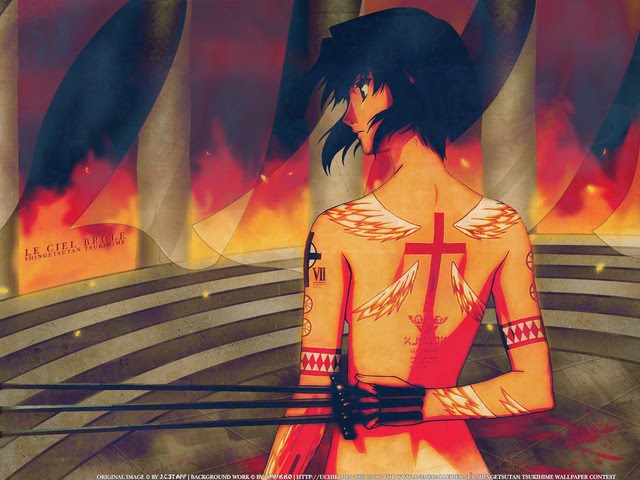
 Tsukihime (月姫 lit. Lunar Princes) is a Japanese eroge dōjin visual novel game created by Type-Moon, who first released it at the Winter Comiket in December 2000. It was adapted in 2003 into an anime series, Shingetsutan Tsukihime, produced by J.C.Staff and Geneon, and a manga series, which has been serialized since 2004 in MediaWorks' seinen magazine Dengeki Daioh, with seven bound volumes having been released so far.
Tsukihime's official subtitle states: "Blue Blue Glass Moon, Under The Crimson Air". Its fame and renown is often attributed to its comprehensive and expansive storyline and its writer Kinoko Nasu's unique style of storytelling. As well as its anime and manga adaptations, it has also spawned numerous merchandising and memorabilia franchises. A remake to the series is also currently being planned.
An unofficial translation patch for Tsukihime was released on November 5, 2006.




Saiyuki Wallpapers II
Saturday, June 18, 2011

Saiyūki is the Japanese name for Journey to the West, or Xīyóujì (西遊記 "Record of the Journey to the West") in Chinese. While Saiyūki is normally written "西遊記",
or "Journey to the West", Kazuya Minekura writes the title as "最遊記", or "Journey to the Extreme". This is her pun, as both are pronounced saiyūki. Saiyūki is not the first anime to adapt the story of Journey to the West, with the more famous Dragonball series being a primary example.
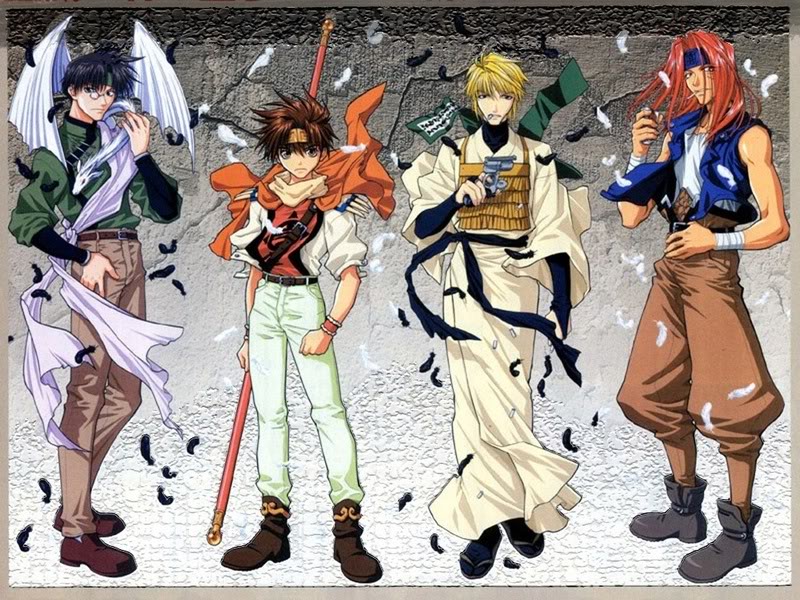
Minekura's Sanzō-Ikkō bears only a superficial similarity to the original four in the Chinese novel. Their names are the same as the names of the characters in the Chinese novel, but given Japanese pronunciations:
- Genjyo Sanzo (玄奘三蔵) is Xuánzàng (玄奘) or Táng-Sānzàng (唐三藏, Tang's three scriptures).
- Son Gokū is Sūn Wùkōng (孫悟空), or the Monkey King.
- Cho Hakkai is Zhū Bājiè (豬八戒), a pig monster. His original name, Cho Gonou is actually Zhū Wùnéng (豬悟能), the Buddhist name given to Zhu Bajie by Guan Yin when they first met in the original novel.
- Sha Gojyō is Shā Wùjìng (沙悟淨), a water demon, classified as a kappa in some translations.
- Gyūmaōh is Niumowáng (牛魔王) Ox King


Gensoumaden Saiyuki is distributed in North America by ADV Films and comprises 50 episodes, which has a large amount of material added for the anime. The sequels Saiyuki Reload and Saiyuki Reload Gunlock are licensed by Geneon in North America, and consist of 25 and 26 episodes respectively. Saiyuki Reload is faithful to the manga from the fourteenth episode and onward, having deviated from it for the first 13 episodes. Saiyuki Reload Gunlock also starts off deviated from the manga, until midway into the series, but strays from it during its finale. Due to the change in licensing, the English voice cast is not consistent throughout all three series, and the characterization and general feel of the series may change noticeably in the second and third installments.
Enoki Films holds the US license to Saiyuki under the title Saiyuki: Paradise Raiders, yet ADV chose not to use this subtitle. There has also been a movie (Saiyuki: Requiem) adapted into English that is also licensed by ADV. A new OVA has been released by Studio Pierrot, which covers the "Burial" arc of the Saiyuki Reload manga; it is called Saiyuki Burial. The studio is currently working on producing an OVA based on of Saiyuki Gaiden


On March 18, 2004, in Japan, a Saiyuki Reload roleplaying video game was released by Bandai. The player is an original character who journeys with Genjyo Sanzo, Son Goku, Sha Gojyo and Cho Hakkai. The player commands the four in menu-based battles that allow for attacks, special attacks, and combination attacks. The game tells an original story, and Bandai included a bonus Saiyuki Reloaded voice CD for those who pre-ordered.
Saiyuki Reload Gunlock was released in Japan on August 5, 2004, by Bandai, this fighting game features a total of eight playable characters including Sanzo, Goku, Gojyo and Hakkai as well as Kougaiji, Chin Yisou, Kamisama, and Hazel. Playable game modes include traditional single and multi-player modes, as well as Practice Mode, Watch Mode, and a story-akin Dramatic Mode.


Record of Lodoss War Wallpapers
Friday, May 20, 2011
 Record of Lodoss War (ロードス島戦記 Rōdosu-tō Senki) is a franchise of fantasy novels by Ryo Mizuno based around the work he originally created for a world called Forcelia for role-playing games (RPGs). There have since been multiple manga, anime and computer game adaptations, several of which have been translated into English. The plots generally follow the conventions and structure of the RPG systems including Dungeons & Dragons and Sword World RPG, being based around a party of several characters of distinct types undertaking a specific quest.
 Record of Lodoss War was created in 1986 by Group SNE as a Dungeons & Dragons "replay" serialized in the Japanese magazine Comptiq. Replays are not novels, but transcripts of RPG sessions, meant to both hold the interest of readers and convey the events that took place. They have proven to be popular, even to those who do not play role-playing games but are fans of fiction (including fantasy fiction). Similar to light novels, many characters and parties in replays have become popular as characters of anime. An example of such a character is the female elf Deedlit in Record of Lodoss War, who was played by science fiction novelist Hiroshi Yamamoto during the RPG sessions.


