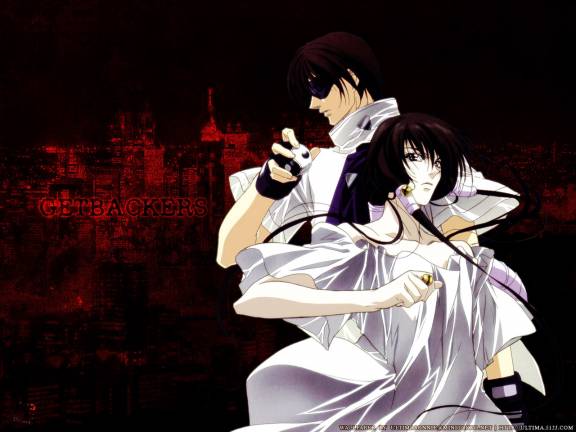
Get Backers Wallpapers  

Wednesday, June 16, 2010


GetBackers (ゲットバッカーズ -奪還屋- Gettobakkāzu Dakkan'ya) is a manga series written by Yuya Aoki and illustrated by Rando Ayamine. The series was serialized and is published by Kodansha's Weekly Shōnen Magazine from 1999 until 2007, totaling 39 volumes.

The manga was adapted into an animated television series in 2002. The Studio Deen production aired on the Tokyo Broadcasting System from October 5, 2002 until September 20, 2003, for a complete run of 49 episodes. It was also dubbed in English and broadcast by the anime television network Animax across its respective networks worldwide, including East Asia, Southeast Asia, South Asia, and South America.

The series was licensed for an English-language release in North America by TokyoPop, which released 27 volumes between February 10, 2004 and December 2, 2008. It has since lost the license to the property, and all existing releases are considered to be out-of-print.

-->read more...

AddThis Social Bookmark Button


Genshiken Wallpapers  

Tuesday, June 15, 2010


Genshiken (げんしけん) is a manga series by Shimoku Kio about a college club for otaku (extremely obsessed fans of various media) and the lifestyle its members pursue. The title is a shortening of the club's official name, Gendai Shikaku Bunka Kenkyūkai (現代視覚文化研究 会), or "The Society for the Study of Modern Visual Culture". The series has also been adapted into an anime directed by Tsutomu Mizushima. The manga originally ran in Kodansha's monthly manga anthology Afternoon from June 2002 to June 2006, and has been reprinted in nine bound volumes. The ninth and final volume was released in Japan in December 2006.

A two-part short bonus story was included across both volumes of the Kujibiki Unbalance manga, published 2006/7. Three years after the original manga ended, a new chapter (Chapter 56) of the Genshiken manga was released as a bonus together with the Japanese "Genshiken 2" DVD box-set. The chapter told us what the characters had become, and what was happening in the Genshiken club right now.

-->read more...

AddThis Social Bookmark Button


Gankutsuou Wallpapers  

Monday, June 14, 2010


Gankutsuou: The Count of Monte Cristo (巌窟王 Gankutsuō, literally The King of the Cave) is an anime series loosely based on Alexandre Dumas, père's classic French novel, Le Comte de Monte-Cristo. Spanning 24 episodes, it was produced by Gonzo, directed by Mahiro Maeda and broadcast by Animax across its respective networks in Japan, East Asia, Southeast Asia, South Asia, Latin America, and other regions.

Gankutsuou's unusual visual style layers Photoshop textures into digital animation, with backgrounds often rendered in 3D. The series features several famous pieces of classical music, including Tchaikovsky's Manfred Symphony, the Donizetti opera Lucia di Lammermoor, and Rachmaninoff's Piano Concerto No. 2. Gankutsuou is set in the far future, during the year 5053, whereas Alexandre Dumas's original novel takes place during the 1800s. Though Gankutsuou incorporates elements of science-fiction and fantasy, it also retains many aesthetics of France in the 1800s, particularly in regard to social classes and wealth. In addition, each of the episodes begin with a summary spoken in French.

Geneon Entertainment acquired the North American release rights for Gankutsuou released it under the title Gankutsuou: The Count of Monte Cristo. As of September 12, 2006, all six volumes have been released on DVD. A box set was also released as a compilation of the six DVDs. On December 27, 2008, Funimation announced that they had acquired the license and planned to release the series in 2009
-->read more...

AddThis Social Bookmark Button


Galaxy Angel Wallpapers  

Sunday, June 13, 2010


Galaxy Angel (ギャラクシーエンジェル Gyarakushī Enjeru) is a bishōjo sci-fi/comedy anime, manga and dating sim series by BROCCOLI. It was created in July 2000, when Broccoli launched the multi-platformed project called Project G.A. The anime and Galaxy Angel Party manga comprise a comedy story in an alternate universe, while the games and the regular manga have a serious and involved romance/action plot.

A sequel to the game trilogy was released in June 2006, entitled "Galaxy Angel II: Zettai Ryouiki no Tobira", and stars an entirely new cast, the "Rune Angel Troupe", and a new feature that combines the new Brave Heart frame with any of the Angels. Each of the Rune Angels has a connection to one of the Galaxy Angels, such as Apricot Sakuraba, the younger sister of Milfeulle Sakuraba. Just like the original Galaxy Angel, the Galaxy Angel II series will have multiple games and already has a manga adaptation and comedic anime spinoff, both of which are currently running. The second Galaxy Angel II game was released in October 2007 entitled Galaxy Angel II Mugen Kairou no Kagi.

The success of the video game and anime series influenced the creation of a manga series based on the video game universe.

In Japan, the series became so popular that a musical based on the series was made. Entitled "GALAXY ANGEL ~The Musical~", it debuted in March and December 2005, and featured cast members who also worked on Galaxy Angel II.

-->read more...

AddThis Social Bookmark Button


Future Studio Wallpapers  

Monday, June 7, 2010


Saint Seiya (聖闘士星矢 Seinto Seiya), also known as Knights of the Zodiac, is a Japanese manga series written and illustrated by Masami Kurumada and serialized in Weekly Shōnen Jump from 1986 to 1991, and adapted into an anime TV series by Toei Animation from 1986 to 1989.

The story follows five mystical warriors called the "Saints" (or "Knights") who fight wearing sacred armors named "Cloths" , the designs of which derive from the various constellations the characters have adopted as their destined guardian symbols. These Saints have sworn to defend the reincarnation of the Greek goddess Athena in her battle against the other Olympian gods who want to dominate Earth.

Both the original manga and the anime adaptation were very successful in Japan and several European and Latin American countries, including France, Italy, Spain, Mexico, Brazil and Argentina; however, neither of them were translated in English until 2003. Four animated feature films were even shown in Japanese theaters; however, the anime was cancelled and left unfinished in 1989, leaving one arc of the manga non-animated. In 2002, Toei Animation continued the anime in the form of three OVA series (the final one ended in 2008) in order to adapt the remaining manga story arcs, and following this revival of the franchise, a fifth film was screened in 2004.
-->read more...

AddThis Social Bookmark Button


Design by Amanda @ Blogger Buster