Uragiri wa boku no namae o shitte iru  

Saturday, April 3, 2010


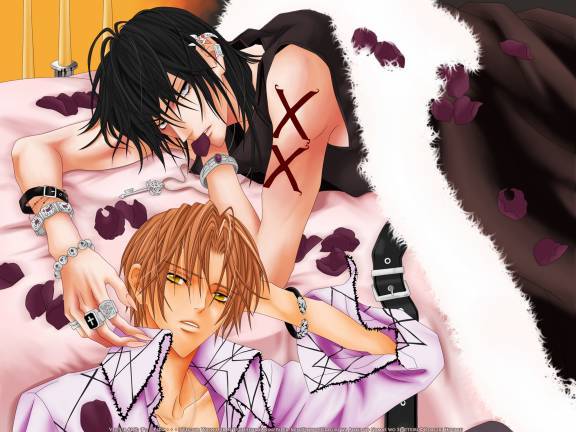
Uragiri wa Boku no Namae o Shitteiru (裏切りは僕の名前を知っている Betrayal Knows My Name), also known as UraBoku, is the title of a Shōjo manga by Odagiri Hotaru. It premiered in the Shōjo magazine Monthly Asuka in October 2005. An anime adaptations will begin in April, 2010 on Chiba TV.
Sakurai Yuki is a mysterious boy with a mysterious power. Right after he was born, his mother left him near an orphanage, and he was later found. Because of that event, Yuki strives for independence. He hates being a burden to anyone near him, but at the same time, he is afraid of being left alone. Moreover, ever since he can remember he had a strange ability where when he touches others, he can feel their emotion. Unable to control it, he often made insensitive blunders in the past. He later meets with a mysterious yet beautiful man who saves his life, but somehow he feels so nostalgic, like he's met him before. While death threats and his ability increasing, a man who claimed to be his older brother suddenly appears, so what will Yuki do when he learns the truth?
-->read more...

AddThis Social Bookmark Button


Saint Seiya! Version Woman Very Baeuty And Cute!  

Friday, April 2, 2010


Saint Seiya (聖闘士星矢 Seinto Seiya), also known as Knights of the Zodiac, is a Japanese manga series written and illustrated by Masami Kurumada and serialized in Weekly Shōnen Jump from 1986 to 1991, and adapted into an anime TV series by Toei Animation from 1986 to 1989.

The story follows five mystical warriors called the "Saints" (or "Knights") who fight wearing sacred armors named "Cloths" , the designs of which derive from the various constellations the characters have adopted as their destined guardian symbols. These Saints have sworn to defend the reincarnation of the Greek goddess Athena in her battle against the other Olympian gods who want to dominate Earth.

Both the original manga and the anime adaptation were very successful in Japan and several European and Latin American countries, including France, Italy, Spain, Mexico, Brazil and Argentina; however, neither of them were translated in English until 2003. Four animated feature films were even shown in Japanese theaters; however, the anime was cancelled and left unfinished in 1989, leaving one arc of the manga non-animated. In 2002, Toei Animation continued the anime in the form of three OVA series (the final one ended in 2008) in order to adapt the remaining manga story arcs, and following this revival of the franchise, a fifth film was screened in 2004.
-->read more...

AddThis Social Bookmark Button


An umbrella or parasol (also called a brolly, rainshade, sunshade, gamp or bumbershoot) is a canopy designed to protect against rain or sunlight.  

Thursday, April 1, 2010


An umbrella or parasol (also called a brolly, rainshade, sunshade, gamp or bumbershoot) is a canopy designed to protect against rain or sunlight. The term parasol usually refers to an item designed to protect from the sun; umbrella refers to a device more suited to protect from rain. Often the difference is the material; some parasols are not waterproof. Parasols are often meant to be fixed to one point and often used with patio tables or other outdoor furniture. Umbrellas are almost exclusively hand-held portable devices; however, parasols can also be hand-held. Umbrellas can be held as fashion accessories.

The word umbrella comes from the Latin word umbra, meaning shade or shadow (the Latin word, in turn, derives from the Ancient Greek ómbros [όμβρος].) Brolly is a slang word for umbrella, used often in Britain, New Zealand, Australia, and South Africa, Bumbershoot is a fanciful Americanism from the late 19th century.
-->read more...

AddThis Social Bookmark Button


Blood And Girl! Very awful  

Wednesday, March 31, 2010


Blood is a specialized bodily fluid that delivers necessary substances to the body's cells – such as nutrients and oxygen – and transports waste products away from those same cells.

In vertebrates, it is composed of blood cells suspended in a liquid called blood plasma. Plasma, which comprises 55% of blood fluid, is mostly water (90% by volume), and contains dissolved proteins, glucose, mineral ions, hormones, carbon dioxide (plasma being the main medium for excretory product transportation), platelets and blood cells themselves. The blood cells present in blood are mainly red blood cells (also called RBCs or erythrocytes) and white blood cells, including leukocytes and platelets. The most abundant cells in vertebrate blood are red blood cells. These contain hemoglobin, an iron-containing protein, which facilitates transportation of oxygen by reversibly binding to this respiratory gas and greatly increasing its solubility in blood. In contrast, carbon dioxide is almost entirely transported extracellularly dissolved in plasma as bicarbonate ion.

Vertebrate blood is bright red when its hemoglobin is oxygenated. Some animals, such as crustaceans and mollusks, use hemocyanin to carry oxygen, instead of hemoglobin. Insects and some molluscs use a fluid called hemolymph instead of blood, the difference being that hemolymph is not contained in a closed circulatory system. In most insects, this "blood" does not contain oxygen-carrying molecules such as hemoglobin because their bodies are small enough for their tracheal system to suffice for supplying oxygen.

Jawed vertebrates have an adaptive immune system, based largely on white blood cells. White blood cells help to resist infections and parasites. Platelets are important in the clotting of blood. Arthropods, using hemolymph, have hemocytes as part of their immune system.

Blood is circulated around the body through blood vessels by the pumping action of the heart. In animals with lungs, arterial blood carries oxygen from inhaled air to the tissues of the body, and venous blood carries carbon dioxide, a waste product of metabolism produced by cells, from the tissues to the lungs to be exhaled.

Medical terms related to blood often begin with hemo- or hemato- (also spelled haemo- and haemato-) from the Ancient Greek word αἷμα (haima) for "blood". In terms of anatomy and histology, blood is considered a specialized form of connective tissue, given its origin in the bones and the presence of potential molecular fibers in the form of fibrinogen.

-->read more...

AddThis Social Bookmark Button


Design by Amanda @ Blogger Buster